
Beregond’s Map Transliteration

Full picture of the transliterated version of Beregond’s Map of Middle Earth
I finished working on this, my most recent map, not too long ago. I drew the original design without the transliteration on 22x30 inch Arnhem cotton paper using archival ink. We now have a number of related products available (all written in the original Tengwar, without any Latin letters):
Standard prints of the map are 20x30 inches, perfect for display and maintaining a high level of detail.
Small prints at 18x24 inches - for those looking to take up less wall space, while not being so small as to lose the details
Gilded prints at 20x30 inches - I have so far gilded 5 prints by hand using dip pens and Windsor and Newton gold calligraphy ink. It has a nice metallic sheen and imparts a more medieval feel to the map. I’ll likely gild some more when I can find the time; it takes 2-3 hours for each map.
High-quality prints on watercolor paper — I recommend these for any who wish to watercolor the map themselves. I have 3 such prints at the moment and will be able to procure more if there’s enough interest.
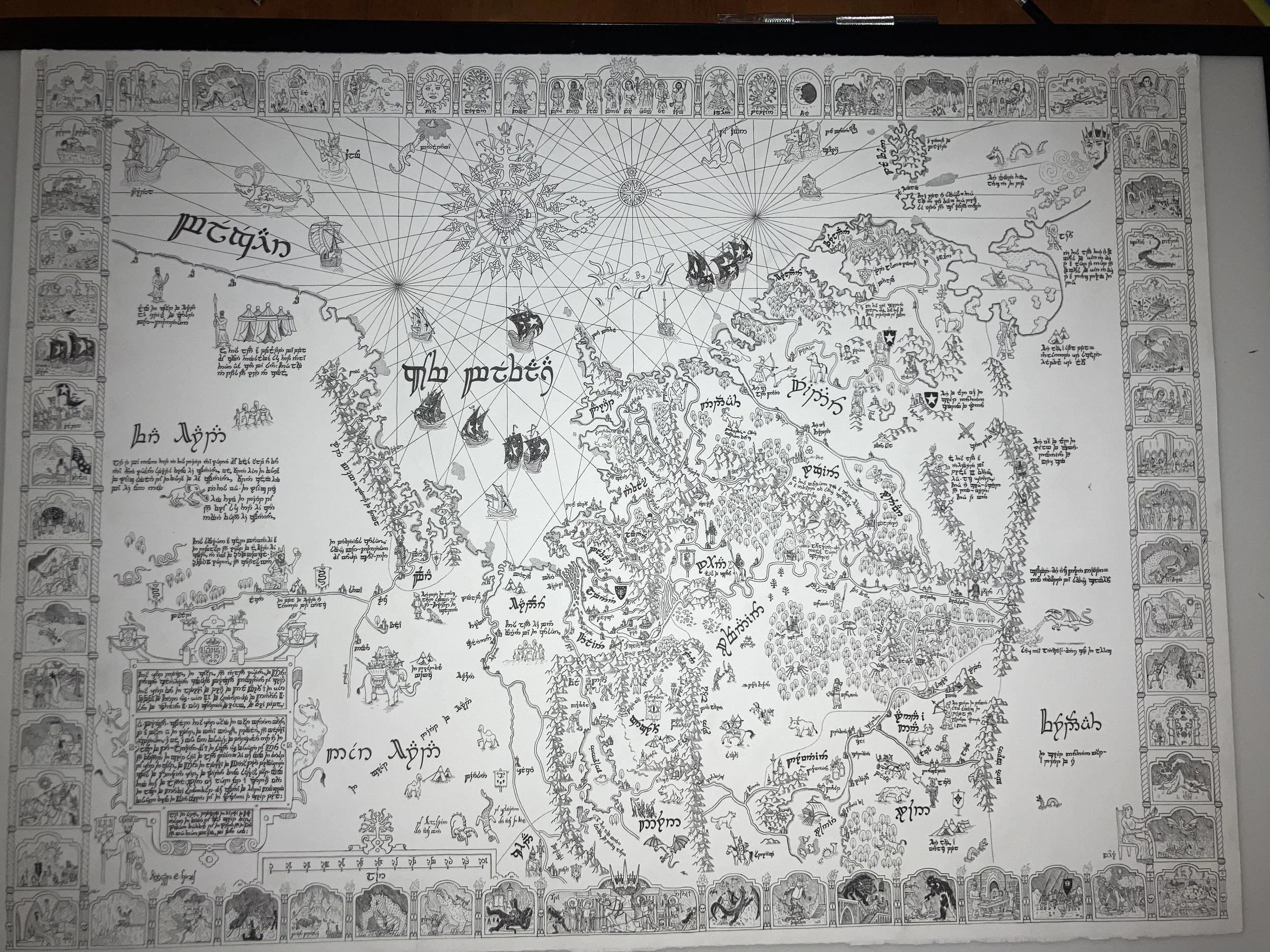
Beregond’s Map - my original design and the design I use for all prints - written fully in Tengwar characters.
In designing this map to appear like an in-world artifact, I drew much inspiration from medieval and early modern European cartography, so it was a no-brainer to look to the inscriptions of the Catalan Atlas of 1375 when deciding what to write. The Catalan Atlas is remarkable for its accurate depiction of the Mediterranean and Black Sea regions, as well as its relatively secular and factual descriptions of the peoples living there. Of course, the map greatly distorts not only the geography of the more eastern regions it depicts, but also describes them in outlandish terms, leading to some fun inscriptions such as “The men of this land are twelve fathoms high, like giants. They are grey-skinned and dim-witted. They eat men.” and “These people are savages. They live on raw fish; they drink sea water and go around naked.” I referenced many of these inscriptions, but made some alterations to make them better fit Middle Earth. I also came up with many other inscriptions drawing on my research and some suggestions by folks online, including the reference to Tar-Aldarion in the cartouche in the lower lefthand portion of the map.

From top right — Ormal (the southern Lamp of the Valar); Laurelin (the Golden tree that replaced Ormal and preceded the sun); the sun; Morgoth destroys the Lamps of the Valar; Aulë prepares to destroy the dwarves he created in repentance for seeking to create life, which is Eru Ilúvatar’s place alone, but Eru stays his hand; first chaining of Melkor at the hands of Tulkas after his defeat in the War for the Sake of the Elves and the destruction of his first great fortress of Utumno; Melkor unchained in Valinor after an age of captivity; men awaken in Hildórien; Túrin Turambar ends his life; Númenor; the hand of Eru ends Ar-Pharazôn the Golden’s invasion of the Undying Lands and drowns Númenor while the faithful escape to Middle Earth.
The Meneltarma, the sacred mountain at the heart of Númenor, is depicted on this map, surrounded by rocky shoals or sandbars. It has not been seen since the doom of Númenor, but is said to still poke above the waves. In reality, it should be much farther to the south and west, but given that it hasn’t been seen in three thousand years, its exact placement is less important than depicting it for its religious significance.
One fact I found particularly interesting is that the Gondorian and Elvish number systems use base 12. As such, when laying out the scale I had it go from 0 to 144 lár (Gondorian leagues) in increments of 12. The inscription next to the Haradrim sovereign Marwan (modeled on the Catalan Atlas’s depiction of Mansa Musa) describes him as commanding an army of 864 Mûmakil, 62,208 riders, and countless men. Likely an overestimate by a large margin made by far-off Gondorian scholars and military officials, these numbers seem oddly specific in base 10 — but in base 12 they are represented as nice round numbers, as we might expect estimates to be. What we represent in base 10 as 864 would be written as 600 in base 12, and what we represent as 62,208 in base 10 would be rendered as a nice round 30,000 in base 12.

The inscription in the cartouche references Tar-Aldarion - the sixth king of Númenor, first of the Dúnedain to venture back to Middle Earth since their forefathers fled the sinking of Beleriand at the end of the First Age.
The cartouche also references Elendil’s maps of Eriador. Elendil, father of Isildur, led the Faithful as they fled from the Doom of Númenor, and it was he who founded the great northern kingdom of Arnor near the end of the Second Age. Arnor fell into ruin by the middle of the Third Age, while its southern counterpart in Gondor prospered. Gondorians are avid seafarers, but as of the late Third Age they have only loose connections now with inland Eriador, so would likely be reliant on old charts of the region for their maps.
The great port of Umbar is controlled by the Black Númenoreans (Môr Dúnedain), so called because, unlike the Faithful, they turned from the Valar and Eru Ilúvatar and took to worshipping Sauron and Morgoth in pursuit of achieving immortality. Umbar and Gondor have long been enemies. Gondor was once able to subdue and conquer Umbar, but it has since regained its independence and expanded its maritime power as Gondor’s influence waned over the late Third Age. The Corsairs of Umbar have even established a foothold in Harondor, or South Gondor. They are described in this map as perfidious, or oath-breaking.
Ar-Pharazôn the Golden is depicted twice in this map - once in Near Harad where he captured Sauron before bringing him to Númenor, and once in the iconographic border, being sucked into the earth alongside his army and fleet by an act of Eru Ilúvatar as a result of his blasphemous invasion of the Undying Lands, which led to the downfall and drowning of Númenor by Eru’s hand.
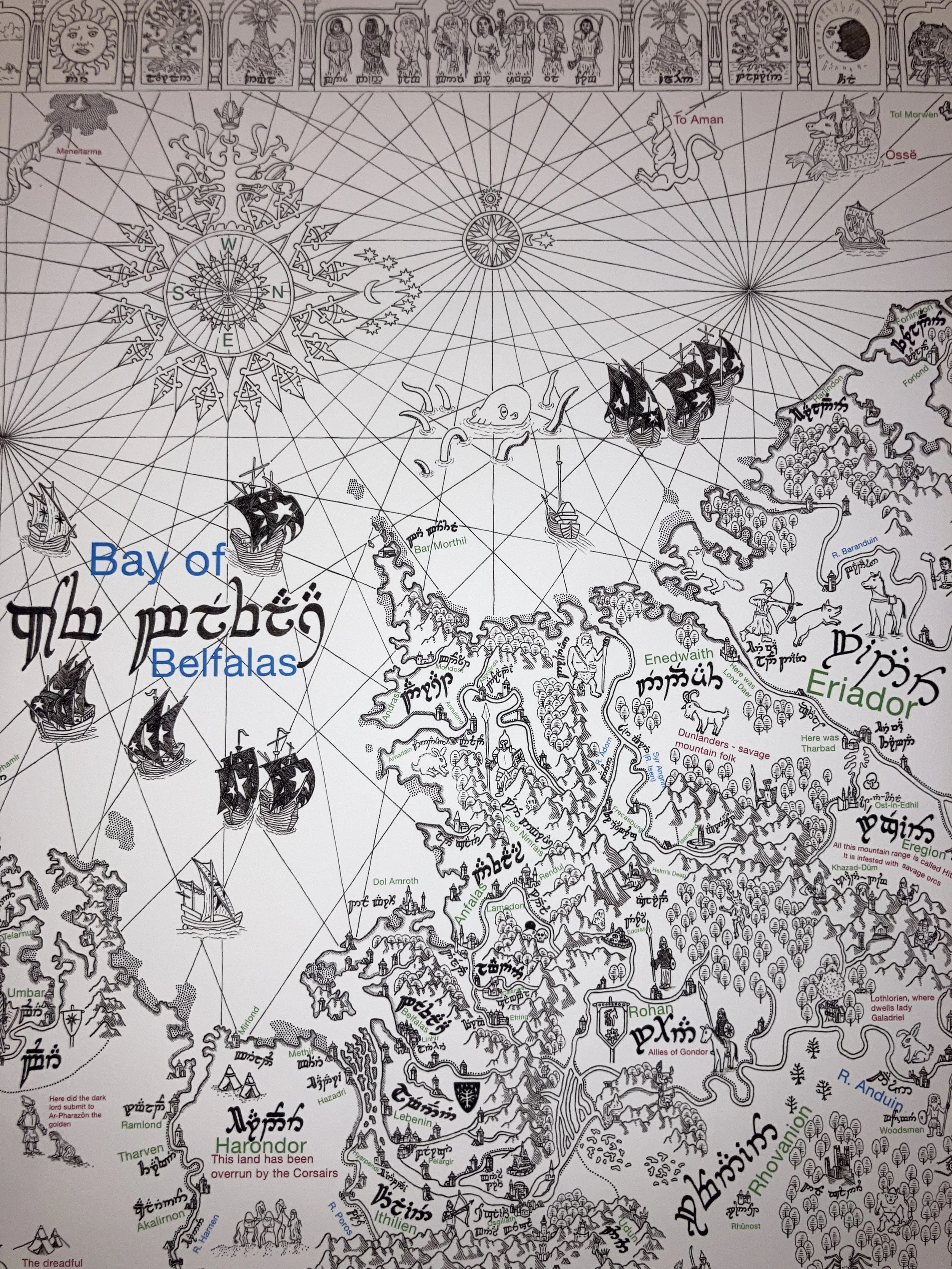
At top - the Valar, with the hands of Eru carrying the Flame Imperishable above them. To either side - the lights of the world. First came the Lamps of the Valar, which Morgoth cast down before the awakening of the elves. Then the Valar gathered the light up again and concentrated it in two trees which lit the world from the Undying Lands - it was under the light of the trees that elves awoke and migrated from Middle Earth to Aman. At this time the Valar broke Morgoth’s first fortress of Utumno and chained him for an entire age. After being released from his captivity by the Valar, Morgoth collaborated with the giant spider-like entity Ungoliant to destroy the trees immediately before fleeing back to the now-darkened Middle Earth. The Valar gathered the light of the trees and used it to create the sun and the moon in defiance of Morgoth. While Morgoth was defeated and cast into the Void at the end of the First Age, he will return at the end of days and destroy the sun and the moon before initiating the Dagor Dagorath, the Battle of All Battles.
In the ocean are depicted the ships of the Faithful fleeing the destruction of Númenor and landing in Middle Earth to establish the kingdoms of Gondor and Arnor.
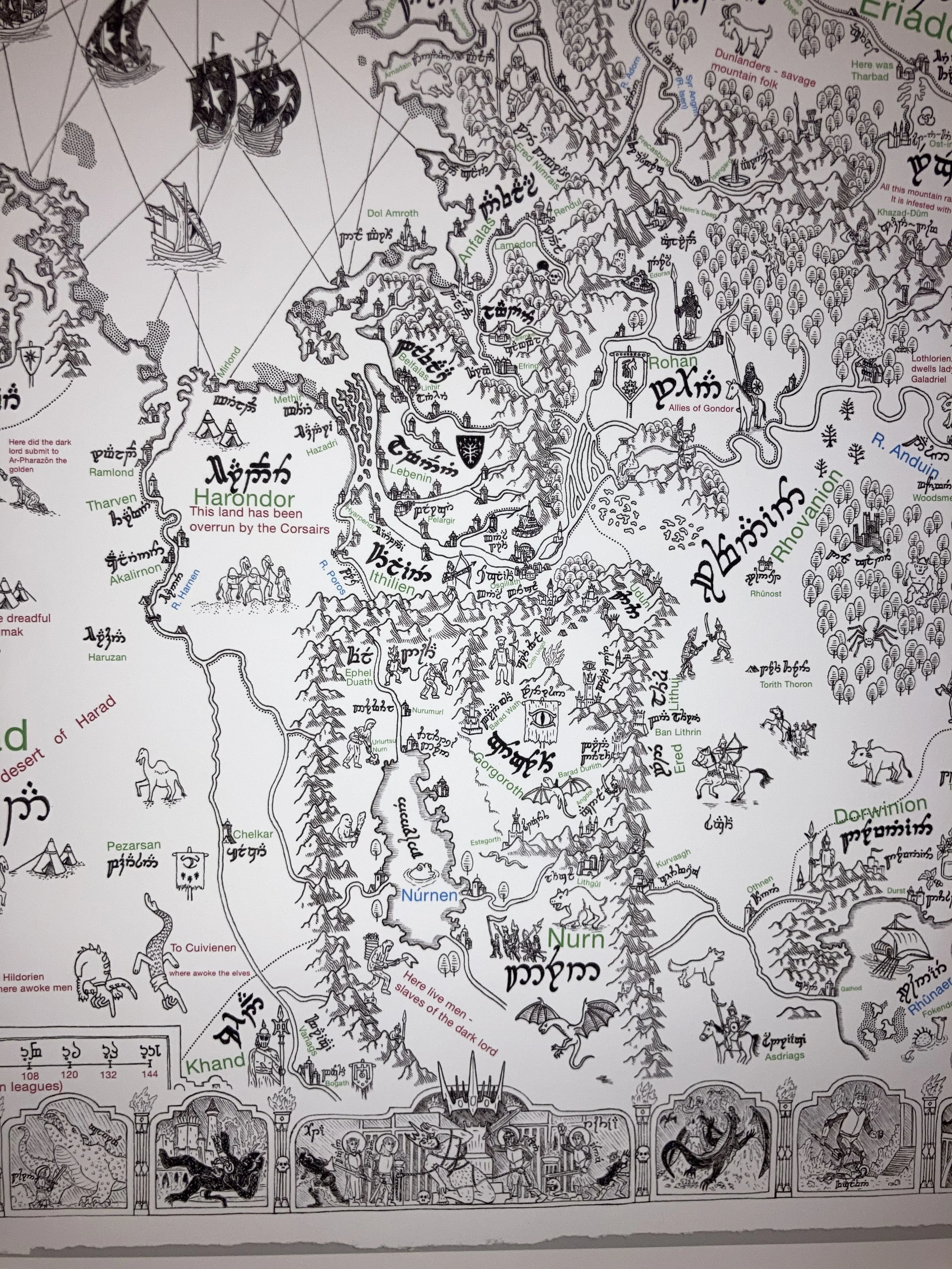
In this part of the map two maniculae point towards the far-eastern birthplaces of men and elves.
Wainriders, scourge of Gondor, are depicted transiting the eastern steppe of Rhovanion from Rhûn.
From bottom left: Turin slays Glaurung, Father of Dragons; Ecthelion slays Gothmog, lord of the Balrogs, at the Fall of Gondolin; the second chaining of Morgoth in the depths of Angband after his defeat in the War of Wrath, after which he was cast into the Void; Eärendil in his flying ship smites Ancalagon the Black upon the Thangorodrim outside Angband; Fingolfin injures Morgoth’s foot as he is crushed to death in his duel with the dark lord.
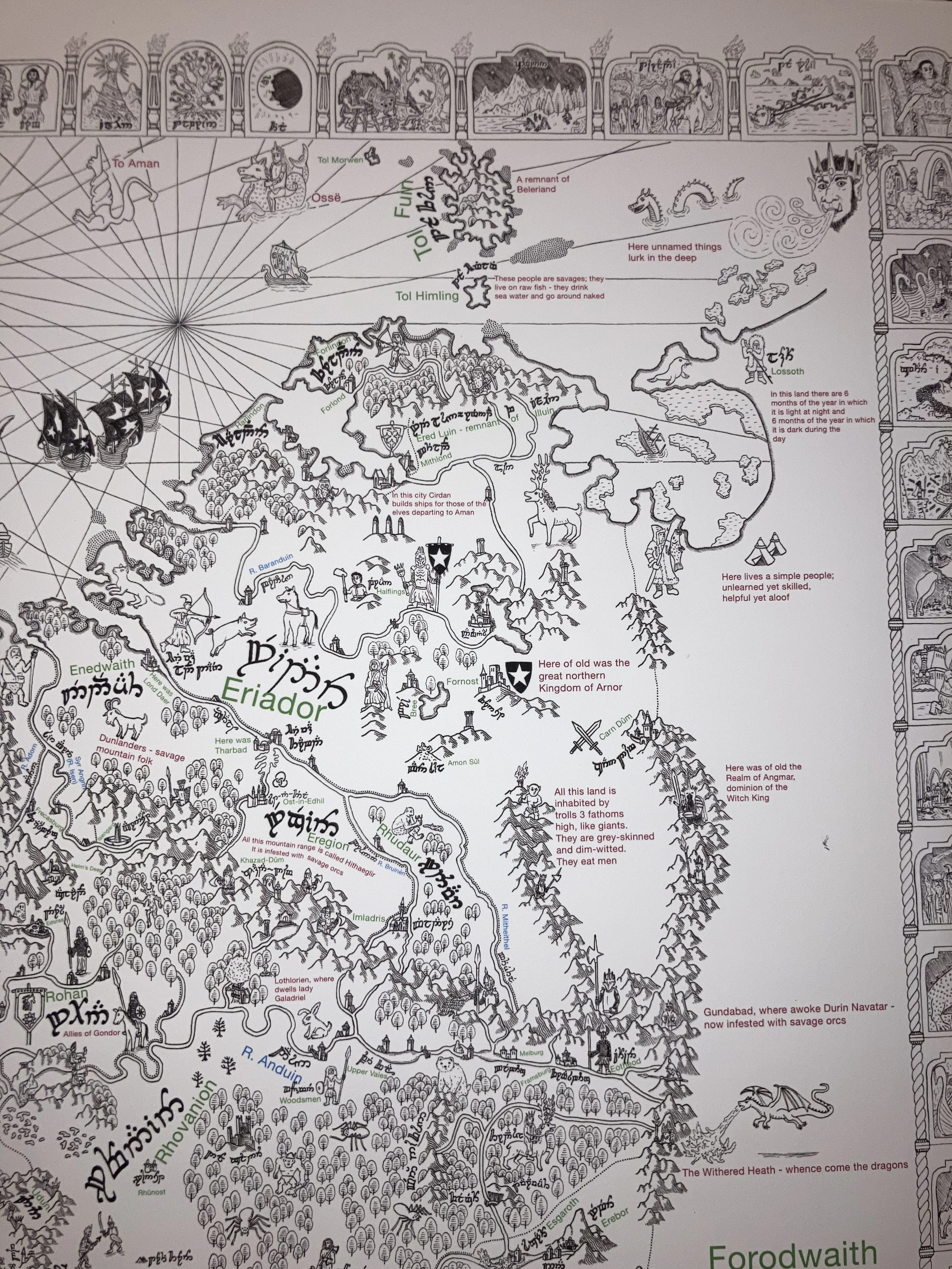
Here unnamed things lurk in the deep - a reference to Morgoth’s fortress Angband, which was drowned along with Beleriand at the end of the First Age, some five thousand years before the Fellowship’s quest. Who knows which of Morgoth’s foul creatures survived the destruction of his fortresses of Utumno and Angband, lurking in caverns far beneath the world’s surface.
Also depicted is Mount Gundabad, where the dwarves first awoke. It has been hotly contested between dwarves and orcs for millennia.
King Arvedui, last king of Arthedain, a successor kingdom to Arnor, is drowned in his ship in the Ice Bay of Forochel after departing from his exile among the Lossoth. His kingdom was undermined by the Witch King’s Realm of Angmar.
The map depicts great ancient cities of the Dúnedain, now ruined — Lond Daer, Tharbad, Annuminas, and Fornost.
The Tower Hills which once housed the palantiri are also shown.
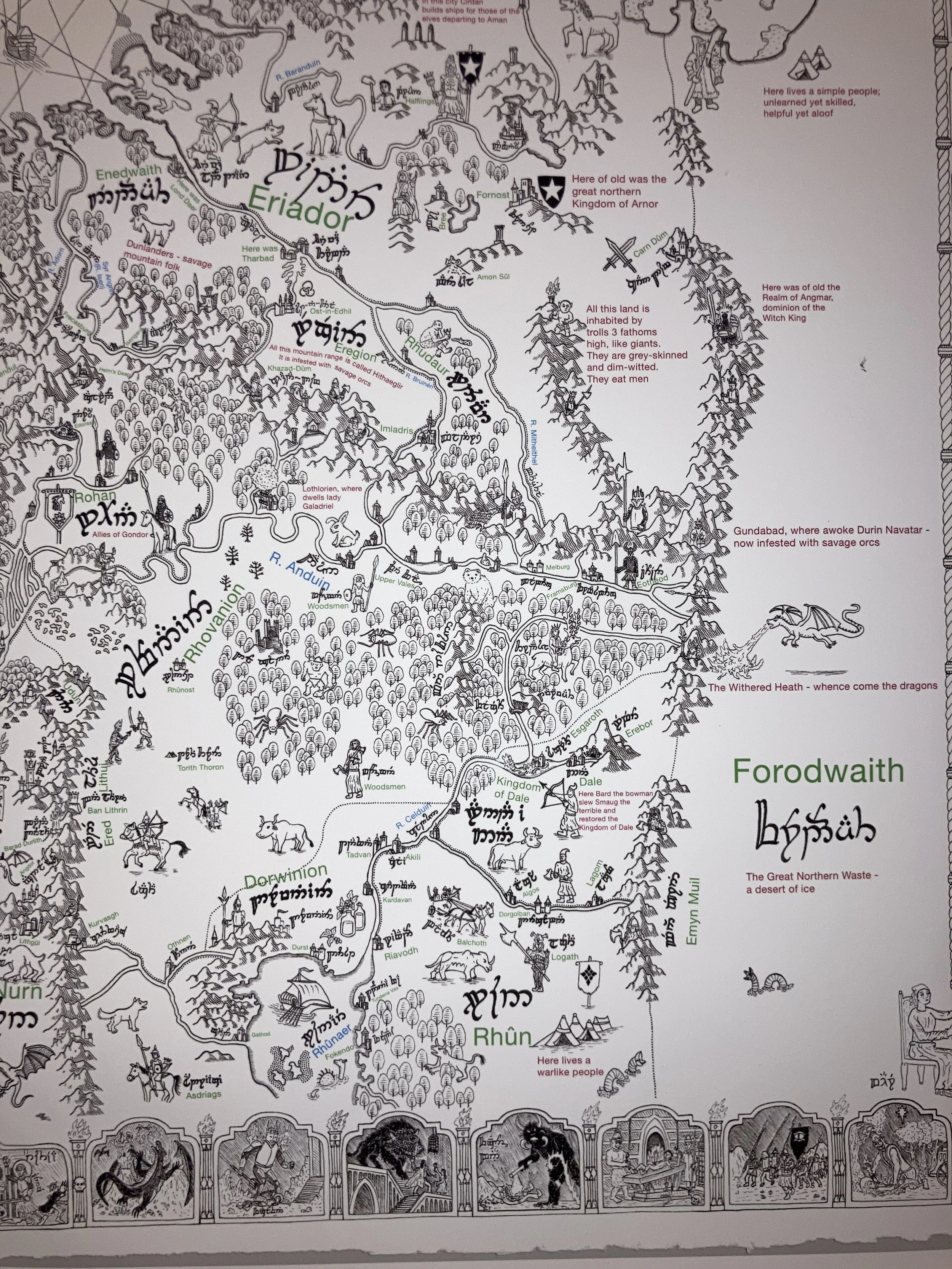
In the northeastern section of the map are depicted were-worms and the horned beast of Rhûn.
From bottom right: Morgoth ravaging sun Maia Arien; orcs on the march; Morgoth and Sauron torture an elf in Utumno; Gothmog, Fingon’s Bane — Gothmog slays the high king of the Noldor; Beren and Luthien in Angband, stealing a silmaril from Morgoth and confronting Sauron in his werewolf form.
Thanks for reading! We have another post coming soon, in which we’ll be showing off the gilded version of the map. I enjoyed gilding a few of the prints and I’m happy with how they turned out; they have a somewhat more medieval feel and really make the map stand out.
“Simple land, simple thing. We have so many places… World is big; a place enough. … Yee, c’mon.” — Speak